Franchise

All Courses

Type a course name or short form (acronym) to find any course quickly.
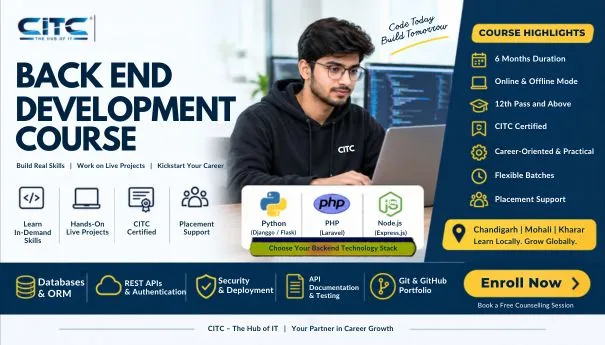
Back End Development

Backend Developer Web Development (BED)

Start Date 1 October 2026
Duration 6 Months
Mode Online / Offline
Certification CITC Certified
Batch / Course BED
Enroll Now

Click here for CITC All Courses FEES

Course Highlights

What you get when you enrol with CITC

Industry-ready Curriculum
Practical Learning
CITC Certificate
Flexible Batches
Placement Support
Career Guidance
1,744+ Franchises
41,756+ Students
445+ Courses
10,439+ Govt. Placements
22,966+ Private Placements
Backend Developer Web Development

Backend Developer – Web Development Expertise

Introduction

Welcome to the Advanced Backend Development Course – a comprehensive 6-month journey into the world of server-side programming, designed for those who want to go beyond the basics of backend and explore how real-world systems are built, optimized, and deployed.

This course covers authentication, data modeling, API creation, API testing tools, databases, and Web Security strategies. From frameworks like Django, Laravel, and Node.js to deployment tools like Render and Railway, this course bridges the gap between theory and real-world application. Available online and offline, you’ll benefit from project-based learning, mentorship, and expert guidance.

Course Papers / Subjects

What you will study in this programme

01
Backend Fundamentals & Setup
02
SQL Databases and ORM Integration
03
REST API Development and Authentication
04
Programming in Your Selected Language
05
File Uploads, Optimization and Deployment
06
Real-World Backend Features
07
Capstone Projects and Final Review

Syllabus (Module-wise)

Expand each topic for details

Module 1

Course Papers

  • Fundamentals of Backend

  • MVC and MVT Architecture
  • Project Folder Structures
  • Routing Logic and Middleware
  • Template Engines: Blade, Django Templates, EJS
  • Local Development Environment Setup
  • Git and GitHub Workflow
  • Introduction to Unit Testing and Linters

  • Relational Database Concepts
  • SQL Queries including JOINs, WHERE, GROUP BY
  • Designing Tables and Defining Relationships
  • CRUD Operations using ORM
  • Database Migrations and Seeders
  • Ensuring Data Integrity and Using Transactions

  • Designing RESTful API Patterns
  • Creating CRUD Routes with Validation
  • Implementing Token-Based Authentication using JWT
  • Securing Routes with Role-Based Protection
  • Input Data Sanitization and Error Handling
  • API Testing using Postman or Thunder Client
Module 2

Course Papers

  • Choose Any one Programming Language

  • Python (Django / Flask): Project Setup and App Structure, ORM with Django ORM or SQLAlchemy, Advanced Model Relationships, REST API with DRF or Flask-Restful, JWT Authentication, Django Admin Customization, File Uploads, Local Deployment with PostgreSQL and Gunicorn
  • PHP (Laravel): Laravel Structure and MVC, Eloquent ORM, Authentication with Breeze/Jetstream, API Resources & Controllers, Sanctum/Passport for API Security, File Uploads & Storage, Middleware & Form Validation, Local Deployment
  • JavaScript (Node.js + Express): Express.js MVC Setup, Sequelize ORM & Relationships, RESTful API Development, JWT Auth with Role Access, File Uploads with Multer, Custom Middleware & Error Handling, Deployment using Railway or Render
Module 3

Course Papers

  • File Handling & Deployment

  • Advanced File Handling and Directory Management
  • File Type, Size, and Path Validation
  • Managing Application Configuration using .env Files
  • Logging, Debugging, and Error Tracking
  • Introduction to Redis Caching for Optimization
  • Deployment with Gunicorn, Nginx, PostgreSQL (Python)
  • Deployment with Laravel Forge or Shared Hosting (PHP)
  • Deployment with PM2, Railway, or Render (Node.js)

  • Role-Based Permissions and Access Control
  • Background Job Processing (Celery, Laravel Queues, Bull.js)
  • Pagination, Filtering, and Sorting in APIs
  • API Documentation with Swagger or Redoc
  • API Versioning for Long-Term Maintenance
  • Security Best Practices (OWASP, CORS, Rate Limiting)

  • Choose Any One: CMS, CRM, Inventory System, Role-Based Admin Dashboard
  • Project Requirements: JWT Auth, SQL + ORM, REST API (CRUD, Filter, Pagination), File Uploads, Admin/User Roles, API Docs (Swagger/Postman), Live Deployment & GitHub Repo
  • Final Deliverables: Project Presentation, Hosted App, GitHub Link, Completion Certificate

What You Will Learn & Career Scope

Details from the course content

Why Choose This Course?

This backend developer course offers a deeper dive into the world of backend development, helping learners build structured and secure web applications from scratch. You’ll gain exposure to various industry-standard frameworks and tools used in real web development environments, from setting up MVC architecture to deploying apps using services like Render, Forge, and Railway.

You’ll also practice advanced Web Security techniques, master tools like Postman, MySQL Workbench, and learn to write clean, scalable backend logic using modern Web Development Tools. The inclusion of Node.js interview questions and JavaScript interview questions further helps in self-assessment and conceptual clarity. Whether your goal is to work as a web developer, grow as a backend software developer, or take on freelance web development work, this course provides a strong technical foundation.

What Will You Learn?

  • Core principles of backend development and web architectures
  • Real-world web programming using Python, PHP, and JavaScript
  • Building secure, RESTful APIs and understanding application programming interfaces
  • Working with databases and performing SQL operations using ORMs
  • Advanced topics like background jobs, caching, and role-based access
  • Writing, testing, and debugging robust backend systems
  • API documentation using Swagger and Postman
  • Understanding interactive mode in Python for testing and exploration
  • Basic Data Structures & Algorithms for backend efficiency
  • Deployment and server hosting techniques for different stacks


Opportunities After This Course

On completion, learners can confidently start building complex backend systems and contribute to full-stack applications. While this course is aimed at deepening backend skills, it opens the door to a variety of paths, including:

  • Backend Developer
  • Backend Software Developer
  • Web Developer specializing in backend
  • Python Web Developer
  • Freelance Web Developer
  • API and Web Security Consultant
  • Contributor to custom web development teams
  • Entry into advanced software development roles


The knowledge gained here prepares you for real-world technical challenges in both solo and collaborative projects.

Who Can Enroll?

This course is ideal for:

  • Learners with basic backend or programming experience
  • Graduates from a web development course looking to specialize in the backend
  • Frontend developers aiming to become full-stack
  • Professionals from other tech roles transitioning into software development
  • Freelancers who want to add advanced backend features to their projects


This course assumes basic familiarity with programming but guides you step-by-step into advanced backend web development.

Enroll Now

Ready to build scalable, secure, and production-ready backend systems? Join our 6-month Backend Development Course and take your backend skills to the next level. Whether you prefer online learning from home or attending offline sessions in person, our flexible format is designed for you. Start building powerful web applications, learn advanced features, and become confident in backend development. Seats are limited – enroll now to begin your backend journey!

Frequently Asked Questions

Common questions about this course

Back-end development focuses on the server-side of a website or application, including databases, APIs, authentication, and application logic. CITC’s Back End Development Course helps learners build secure and functional web applications using modern backend technologies.

CITC’s Back End Development Course has a duration of 6 months. The course is available in both online and offline modes and covers practical backend development skills.

For beginners, a backend development course that covers programming fundamentals, databases, APIs, and server-side development is a good starting point. CITC’s Back End Development Course is designed to help beginners build practical skills step by step.

Yes, you can do backend development with Python using frameworks such as Django and Flask. CITC’s Back End Development Course helps learners understand Python-based backend development and build functional web applications.

The time to learn back-end development depends on your background and learning pace. With consistent practice, beginners can build basic backend skills through CITC’s Back End Development Course and gain practical knowledge step by step

The CITC Back End Development Course syllabus covers backend fundamentals, SQL databases, REST APIs, authentication, programming languages, file handling, deployment, web security, and real-world backend projects. It also includes Python, PHP, and JavaScript-based backend development.

The fee for CITC’s Back End Development Course may vary based on the course and learning mode. For the latest fee details, students can check CITC’s official fee information or contact CITC directly.

The best way to learn backend development is through structured learning, hands-on coding, and real-world projects. CITC’s Back End Development Course helps learners build practical backend skills with guided training and project-based learning.

Yes, CITC’s Back End Development Course includes database concepts such as MySQL and MongoDB. Students learn how to work with databases for storing, managing, and retrieving application data.

The minimum eligibility for CITC Backend course is 12th standard.

Real Stories. Real CITC.

Stories That Inspire Trust

Training at 25 PB Battalion

Training at 25 PB Battalion

Training at 13 PB Battalion

Training at 13 PB Battalion