
Type a course name or short form (acronym) to find any course quickly.
What you get when you enrol with CITC
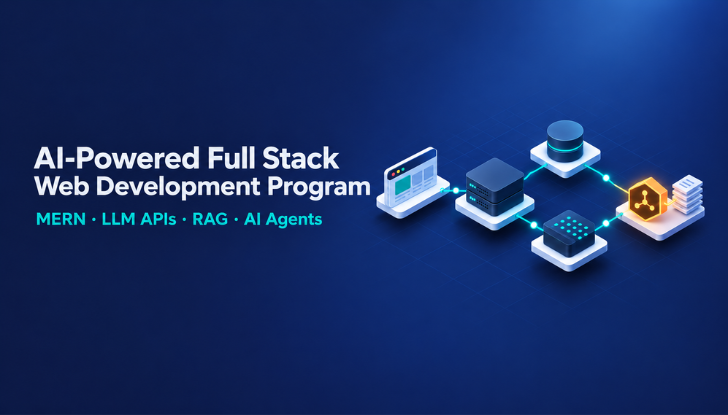
Learn real web development first—then use AI to build smarter applications. CITC’s AI Web Development Course combines frontend, React, MERN fundamentals and deployment with AI-assisted coding, Prompt Engineering, Generative AI, LLM applications, RAG and AI agents.
Designed for beginners, students and aspiring developers, the course focuses on practical projects such as AI chatbots, assistants, smart web apps and AI SaaS concepts while ensuring you still understand the code behind what you build.
What you will study in this programme
Expand each topic for details
Start with the fundamentals every developer needs. Build programming logic, understand modern web technologies and learn HTML, CSS, JavaScript, Git and responsive development before moving into React, MERN and AI-powered development.
Move from basic JavaScript to modern application interfaces. Learn React.js, reusable components, hooks, routing, state management and API integration while building dynamic dashboards and web-app interfaces.
Connect frontend interfaces with backend logic and databases. Learn the MERN development workflow, REST APIs, authentication and data management so you can build functional web applications before adding advanced AI capabilities.
Move beyond conventional web development and learn how to build AI-powered applications using Prompt Engineering, AI-assisted coding, LLM APIs, RAG, vector databases, AI agents and automation workflows.
Details from the course content
Enroll in CITC’s AI Powered Full Stack Web Development Program and start learning practical AI-powered full stack development.
AI-powered web development combines traditional web-development skills with modern Artificial Intelligence capabilities.
Instead of building only static websites or conventional applications, developers can create products that include AI chatbots, intelligent search, content generation, document assistants, recommendation features, automation and other LLM-powered functionality.
The key difference is that students still learn how real web applications work.
You first build foundations in HTML, CSS, JavaScript, React, backend development, APIs and databases, then learn how AI can be integrated into those applications.
This prevents the course from becoming simply a collection of AI tools.
CITC's standard Full Stack Developer Course focuses on the complete conventional web-development workflow:
This AI Web Development Course goes further.
After developing the full stack foundation, learners progress into:
Students who primarily want conventional full stack development can choose the dedicated Full Stack Developer Course. Learners who want to combine coding with modern AI application development can choose this AI-powered path.
Vibe Coding is an AI-assisted software-development approach where developers communicate their intent to AI tools using natural-language prompts.
AI can help suggest code, explain unfamiliar logic, identify errors, generate drafts and accelerate repetitive work.
However, effective Vibe Coding still requires development knowledge.
A developer needs to understand:
In this course, Vibe Coding is taught as a productivity workflow—not as a replacement for learning programming.
Traditional development requires programmers to manually write and debug most parts of an application.
AI-assisted development adds another layer of support.
AI can help developers with:
The developer still remains responsible for understanding, testing and maintaining the final application.
The strongest developers are not those who simply copy AI-generated code—they are those who understand development well enough to use AI intelligently.
This program combines development and AI skills across:
The strongest part of this course is applying AI within actual applications.
Students can explore projects such as:
These projects help learners understand the difference between simply using an AI chatbot and integrating AI into a real web application.
Large Language Models can power many modern application features.
Learners understand how a web application can send instructions to an LLM API, receive a response and display the result inside a usable interface.
This includes concepts such as:
Students learn these concepts through application-oriented examples rather than treating them only as theory.
Retrieval-Augmented Generation, commonly called RAG, allows an AI application to retrieve relevant information from a specific knowledge source before generating an answer.
A simple RAG workflow may look like:
Documents → Processing → Embeddings → Vector Database → Retrieval → LLM → Answer
This approach can be used for applications such as:
Learning RAG helps students understand how developers can create AI systems that work with custom information rather than relying only on a general AI model.
AI agents extend the idea of a chatbot by allowing an AI system to work toward a goal and use tools or workflows.
The course introduces agent concepts, LangChain and automation platforms such as n8n and Make.
Learners can understand how AI workflows may:
Human oversight remains important when AI systems perform actions or handle business information.
An AI website builder can quickly generate a basic website or template.
That can be useful when the requirement is simple.
AI web development is different.
A developer learns how to build and control:
This makes it possible to create applications that go beyond standard website templates.
Development skills become stronger through project work.
Learners progress from foundational websites and React interfaces to MERN applications and AI-powered projects.
Possible projects include:
The objective is to understand how different technologies work together inside a complete project.
A portfolio helps demonstrate practical development ability.
Students can organize suitable work using:
A strong portfolio can be useful during internships, freelance discussions and entry-level developer interviews.
This course can be suitable for:
The program begins with development fundamentals before progressing into advanced AI concepts, making the learning path more structured for beginners.
Depending on practical ability, project quality and employer requirements, learners may explore roles such as:
Specific role requirements vary between employers and projects.
Completing the course does not guarantee employment or a particular salary.
The supplied curriculum is structured across Weeks 1–48, progressing from programming fundamentals through full stack development and advanced AI application development.
Students should confirm the current official course duration, class frequency and batch schedule with CITC before admission.
Course fees can vary according to the current batch, training structure and applicable program package.
Check the current official CITC course fee or contact CITC for the latest fee and batch information.
Learners from Chandigarh, Mohali, Kharar and nearby areas can contact CITC regarding the current availability of this AI-powered development program.
The page remains focused on AI web development skills and project outcomes rather than simply targeting location-based search phrases.
Web development is evolving from building standard websites toward creating increasingly intelligent applications.
The strongest foundation still begins with real coding.
Learn how to build the frontend, connect APIs and databases, understand full stack applications, then extend those skills with Prompt Engineering, LLMs, RAG, AI agents, Vibe Coding and automation.
The result is a development skill set designed for building—not just using—modern AI-powered web applications.
Common questions about this course
Stories That Inspire Trust

Training at 25 PB Battalion

Training at 13 PB Battalion
